
Reviewed · SELF-GUIDED TOURS
Glasgow Private Self-Guided Tour
Glasgow’s best feature is its sharp change of mood. You begin beside a medieval cathedral and Victorian graveyard, then walk through old merchants’ streets, bold street art, grand civic buildings, and the modern shopping centre. The mix of old Glasgow and new Glasgow gives this route more character than a standard list of monuments.
I like the freedom to stop for lunch, coffee, or a drink, and I like the price: $12.37 per person is fair if you use the history, photos, videos, and route guidance. The main catch is the app. You must download it, follow the map yourself, and start each audio section manually. Some users also found the narration too quiet.
Key points before you set out
- Cathedral to St Enoch: The route crosses central Glasgow in one clear line, beginning at Glasgow Cathedral and finishing near St Enoch Subway Station.
- A strong art angle: The walk includes several Glasgow murals, including St Enoch cradling St Mungo, Fellow Residents of Glasgow, and Honey, I shrunk the Kids.
- No physical guide: This is a private self-guided activity for your own group, with audio narration rather than a person meeting you.
- Three weeks of access: You can use the tour during that period, so you are not forced to finish it on the first day.
- Plan for flexibility: The stated time is two to three hours, but stopping for food, museums, photographs, or drinks can turn it into a relaxed half-day walk.
- Check the sound first: Bring headphones and test the audio before leaving the cathedral.
Why this Glasgow walk works

This tour gives you a useful first look at the city without asking you to commit to a full-day excursion. The route links several parts of Glasgow that can feel separate when explored alone: the Cathedral precinct, the Merchant City, George Square, the shopping streets, and the area around St Enoch.
You do not just move from one famous building to the next. The walk explains how Glasgow developed from a religious centre into a commercial city, then into the modern Scottish city you see today. Its strongest theme is change.
The route is also private in a simple but important sense. Only your group takes part, and there is no fixed departure time or live guide. You can pause the experience, return later, or take a longer break. That suits me better than a tightly timed group walk when I want to stop for a photograph or step into a building.
The trade-off is that you are responsible for the tour. The app does not replace a person who can answer a question, point out a detail from across the street, or guide you around a wrong turn. You need to keep an eye on the map and make sure the next audio section has started.
More self-guided tours in Glasgow:
- Glasgow Ghost Hunt: The Soul That Got Away Exploration Game
★ 4.0 · 71 reviews - Cycle To Loch Ness – Self Guided
★ 5.0 · 119 reviews - Harry Potter’s Edinburgh: A Self-Guided Audio Tour
★ 4.5 · 42 reviews
Starting at Glasgow Cathedral
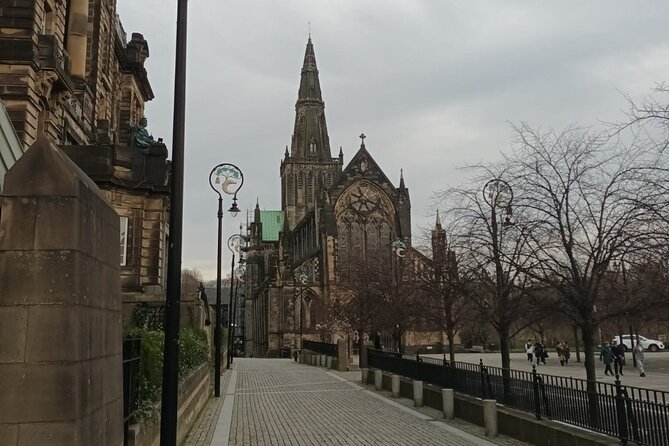
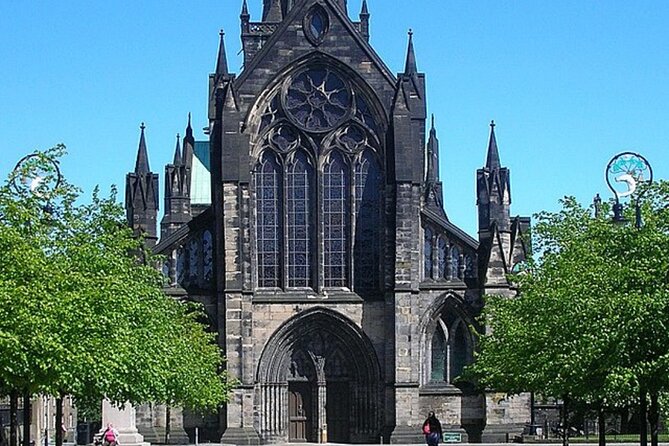
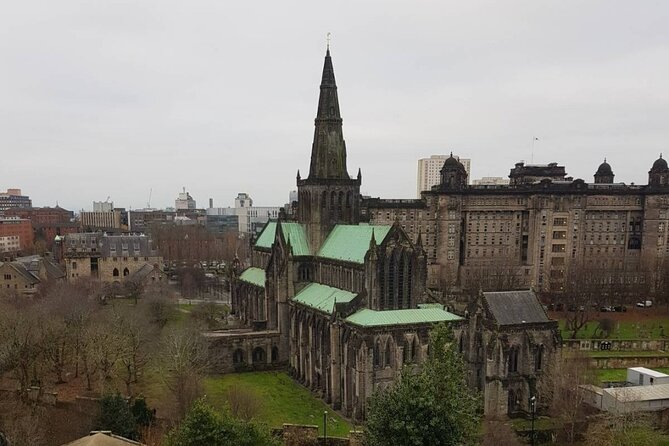
The tour begins at Glasgow Cathedral on Castle Street, one of the city’s most important medieval buildings. The present cathedral dates from 1197, after an earlier church built in 1136 was destroyed by fire. It has remained roofed and in use for more than 800 years.
That long survival gives the opening stop real weight. You are not starting with a quick photo opportunity. You are standing in a place that links Glasgow’s religious identity with its later civic growth.
Allow about 30 minutes here. The cathedral is free to enter according to the tour details, and the audio gives you a way to look at the building with some context instead of simply walking through it. I would begin with the cathedral itself, then use the time around it to get familiar with the app.
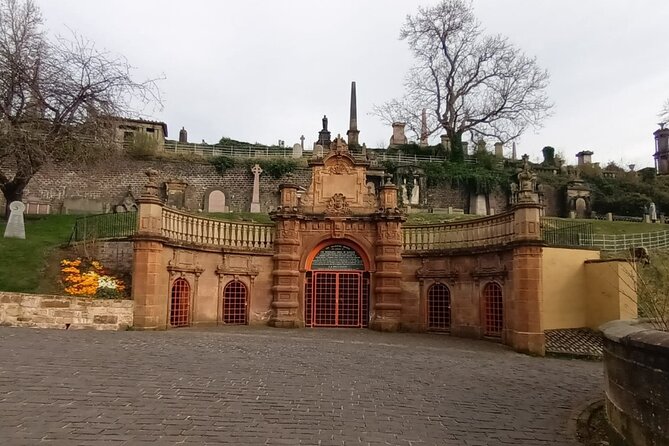
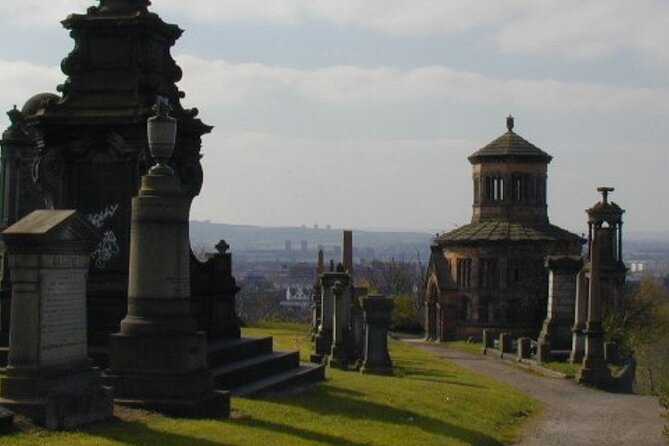
The next stop is the Glasgow Necropolis, directly associated with the cathedral district. This huge cemetery was founded in 1831 and was inspired by Père Lachaise in Paris. Its 37 acres were designed to show the wealth and status of Glasgow’s leading citizens, even after death.
The Necropolis is more than a graveyard. It is a broad outdoor record of the city’s commercial success and social divisions. The scale matters. You are looking across an area of about 150,000 square metres, roughly the size of 15 football fields.
The official stop is listed as 15 minutes, but you can easily spend longer if you enjoy monuments, views, and old inscriptions. The path may also feel more demanding than a flat city street. Take your time, especially if the weather is wet.
Provand’s Lordship and Glasgow’s earliest layers
The route then brings you to Provand’s Lordship, a stone building formerly known as the Hospital of St Nicholas. It is an especially useful stop because it helps connect Glasgow’s cathedral quarter with everyday medieval life.
The building is described in the tour without a separate numbered stop, so pay attention to the app as you move away from the Necropolis. This is one place where a spoken direction to the next point would help. The route does provide a map and GPS directions, but you should not expect the narrator to guide every turn continuously.
That distinction matters. The audio gives you the story at each point, while the map handles the movement between points. If you are used to a walking app that announces every street change, this may feel less smooth.
Strathclyde, murals, and Glasgow’s modern face
The University of Strathclyde is the next named stop. You get about 15 minutes here to look at the university buildings and nearby murals. The stop works because it breaks up the older stonework with a more modern setting.
Glasgow’s murals are one of the best reasons to choose this route. The city has used large wall paintings to revive neglected walls and gable ends, while also changing how people see street art. These are not random decorations added to a sightseeing route. They reflect a deliberate part of Glasgow’s public identity.
The St Enoch cradling St Mungo mural takes only about five minutes, but it deserves more attention than the timing suggests. It shows a mother holding a baby, presenting a futuristic version of St Mungo. The connection to St Mungo and his mother, Thenew, gives the mural a local story rather than making it just a colourful wall.
As you continue, the route passes several additional points of interest. One old stone building served at different times as a town clerk’s office, justice court, town council, and jail. Its upper level was used as a jail for security reasons. This is exactly the kind of small civic detail that can disappear if you walk through the area without explanation.
You also pass the tower of the former Tron Church, now associated with Tron Theatre. Trongate takes its name from the older Saint Thenew’s Gait, a route connected with the supposed burial place of Thenew, also known as St Enoch. The name ties the street, the mural, and Glasgow’s religious stories together.
The route also points out the Glasgow Police Museum, which covers the city’s police force from 1800 to 1975. Glasgow had the first police force in Great Britain, so this is a worthwhile detail for anyone interested in how the city was governed. The museum itself may involve a separate visit, and no entrance fee is included in the tour.
Another Smug mural, Fellow Residents of Glasgow, shows a hiker searching for mushrooms in woodland. Animals from Glasgow’s parks and green spaces appear to emerge through holes in the wall. It is a playful piece, but it also reinforces the tour’s effort to show the city beyond grand buildings.
More things to do in Glasgow:
- Guided Celtic Park Stadium Tour
★ 5.0 · 3,136 reviews - City Sightseeing Glasgow Hop-On Hop-Off Bus Tour
★ 4.5 · 1,873 reviews - Oban, Glencoe, Highlands Lochs & Castles Small Group Day Tour from Glasgow
★ 5.0 · 1,432 reviews - Glasgow City Centre Walking Tour with Local Guide
★ 5.0 · 1,326 reviews
Merchant City at 98 Ingram Street
At 98 Ingram Street, the route returns to Glasgow’s commercial past. The church here was built in 1824 in the Gothic Revival style by English architect Thomas Rickman. Its graveyard contains the graves of tobacco merchants Andrew Buchanan and John Glassford.
This is one of the clearest places to understand how Glasgow’s trade shaped its centre. The older Ramshorn cemetery, now partly covered by Ingram Street, was once the fashionable and costly place to be buried in the eighteenth century. Later, the Necropolis took on that role.
I like the way these cemetery stops work together. The Necropolis shows the grand nineteenth-century version of memorial culture, while Ingram Street points back to the earlier merchant class. You are not just seeing stones and church walls. You are following the city’s money.
The stop itself is listed at five minutes, which is enough for a quick look and explanation. If you want to read grave markers or study the architecture, add time.
From Mercury to George Square

The route then moves through Merchant City and points out a statue of Mercury, the Roman god linked to commerce, travel, luck, trickery, and thieves. The figure stands on a marble plinth and is one of two Mercury sculptures by Alexander Sandy Stoddart. The statues represent the Italian quarter of Merchant City.
This is a compact stop, but it rewards careful looking. Mercury is not simply a classical figure placed for decoration. His connection with commerce suits the district’s trading past.
Next comes Glasgow City Chambers, completed in 1888 and opened by Queen Victoria. The building faces George Square, where a statue of Victoria also appears. The City Chambers are one of the city centre’s major civic landmarks, and the route adds a light film and television connection by noting that the building has served as a registry office in a famous London-based series.
George Square itself was first laid out in 1781 as part of a plan for a Georgian grid. It was not fully developed for another 20 years. That delay helps explain why the square feels both planned and layered, with later monuments and buildings added to an older urban design.
The square is a good place to pause. You can listen while looking at the surrounding buildings, then decide if you want to extend the walk with a break. The tour is at its best when you use the facts as a prompt to observe the city rather than rushing to the next GPS point.
Glasgow’s odd emblem and its major gallery
At another unnamed stop, the tour promises an explanation of one of Glasgow’s more unusual emblems and the city’s sense of humour. The details are delivered through the app, so listen closely here. This kind of local joke can be easy to miss if you are only following a printed route.
The walk also calls out a major Glasgow gallery as a must-see. No entrance fee is included for attractions mentioned along the route, so you should treat any interior visit as optional and allow extra time if you choose to go in.
This is a recurring point with the experience: the $12.37 covers the self-guided material, not admissions. That remains good value for a city walk, but the final cost can rise if you add museums, galleries, or paid sites.
Buchanan Street and the final modern stretch

Buchanan Street is the final named stop and is listed at about 10 minutes. It brings the route into the active centre of present-day Glasgow. By this point, you have moved from the cathedral and medieval stories through tobacco merchants, civic monuments, street art, and modern city life.
The route also points toward The Lighthouse, a visitor centre, exhibition space, and event venue in central Glasgow. It then includes the final Smug mural, Honey, I shrunk the Kids, described as photo-realistic street art.
The finish is near St Enoch Subway Station and a Roman fort reference. Ending at a transport point is practical. You are not left at an isolated landmark with no clear next step. You can continue into the centre, use public transport, or end the walk there.
How long the route really takes
The advertised time is two to three hours, but treat that as a brisk estimate. The route contains enough stops to make a relaxed half-day more natural, especially if you want to look at the murals, enter an attraction, stop for lunch, or pause for a drink.
One useful feature is the three weeks of unlimited access. You can split the experience across more than one day, although the route itself is designed to work as a single walk.
The audio sections do not always start automatically. You may need to open the map, check your position, return to the guide, and select the next section. That can interrupt the flow and sometimes cause the app to lose your place.
Download the Pandemic Tours app before you arrive. Your booking confirmation includes activation instructions, and the booking reference is not the activation code. This is worth sorting out before you reach the cathedral, rather than standing outside while trying to fix an account.
Audio quality and practical app advice
The narrator is identified as Alex in the tour information, and the audio is presented as a human voice rather than a computer-generated one. The content covers history, murals, architecture, local figures, and recommendations. Some feedback also praised the detail and the narrator’s voice.
The weak point is sound quality. One account found the audio low and insufficiently filtered, while another found the app cumbersome because it required repeated movement between the guide and map. These are not minor concerns on a walking tour. If you cannot hear the explanation beside a busy street, the most useful part of the experience disappears.
I would use headphones, charge your phone fully, and download the app before starting. Keep the map open when moving between stops, and pause rather than closing the guide completely. If the app loses its place, you may need to select the stop again.
The tour is offered in English only. Most people can participate, and service animals are allowed. The route is near public transport, but no live guide is present to adjust the pace or route for you.
Who should book it?
I would choose this experience if you want an inexpensive introduction to Glasgow and prefer to set your own pace. It suits solo visitors, couples, families who do not want to keep up with a group, and anyone with only a few hours in the centre.
It is especially good for people who enjoy the link between history and public art. The cathedral, Necropolis, merchant graves, City Chambers, murals, and Buchanan Street give you a broad picture of Glasgow without requiring a full day.
I would not choose it if you expect a person to meet you, answer questions, or lead the way from one stop to the next. I would also think twice if you dislike phone-based tours or find low audio frustrating.
At $12.37, the value is strong if you want a flexible route and will use the extra material for all three weeks. The price is less attractive if you only want a simple map, since Glasgow can also be explored independently. The difference is the supplied narration and the way it connects scattered sights into one story.
Should you book the Glasgow self-guided tour?
Book it if you want a compact introduction that covers Glasgow Cathedral, the Necropolis, historic Merchant City, George Square, Buchanan Street, and several major murals. The route gives you plenty of control and finishes in a convenient central location.
Go in with the right expectation: you are buying a digital guide, not a personal guide. Test the app, carry headphones, allow more than three hours if you like to stop, and use the route as a framework rather than a race. With that approach, this is a low-cost way to see both Glasgow’s old stones and its modern street life.
FAQ
Is this a private tour with a live guide?
No. It is a private self-guided activity for your own group. You follow the route through the app and listen to the audio guide.
Where does the Glasgow tour begin and end?
It begins at Glasgow Cathedral on Castle Street and finishes at St Enoch Subway Station, near the Roman Fort.
How long does the tour take?
The estimated duration is two to three hours. You can take longer by stopping for food, drinks, photographs, or attractions along the route.
What does the price include?
The price includes three weeks of unlimited access to the self-guided tour, a map, directions, GPS route, stop information, audio, videos, pictures, and recommendations.
Is admission to attractions included?
No. Any entrance fees for attractions mentioned during the tour are not included.
What do I need to use the tour?
You must download the Pandemic Tours app after booking and use the activation instructions sent by email. The booking reference is not the activation code.
Just added around Glasgow
- Ultimate Day tour Edinburgh: Glencoe, Highland Cows, Loch Lomond★ 5.0 · 10 reviews
- West of Scotland Cultural Tour★ 5.0 · 7 reviews
- Magicians Heist Private Escape Room in Glasgow★ 5.0 · 23 reviews
- The Braveheart tour from Glasgow or Edinburgh★ 5.0 · 6 reviews
- Private Tour of Glasgow Distilleries and a Loch Lomond Cruise★ 5.0 · 13 reviews
- Scottish Highlands, Lochs & Castles from Edinburgh and Glasgow★ 5.0 · 6 reviews
- Loch Ness and the Scottish Highlands from Glasgow or Edinburgh★ 5.0 · 10 reviews
- Shore Excursion to Loch Lomond & Stirling Castle★ 5.0 · 10 reviews
Self-Guided Tours, compared.

Glasgow Ghost Hunt: The Soul That Got Away Exploration Game
Read our review →
Harry Potter’s Edinburgh: A Self-Guided Audio Tour
Read our review →
500 Years of Crime and Punishment: A Self-Guided Audio Tour
Read our review →
Ghosts of Edinburgh: Bloody Past Exploration Game and Tour
Read our review →
The Dark Side of Aberdeen: A Self-guided Audio Walk
Read our review →
Browse the lists this tour appears in