
Reviewed · HISTORICAL TOURS
St Andrews Old Course History Tour, for the Golfer
The best part of this St Andrews tour is the chance to walk across the Old Course fairway rather than simply view it from a roadside path. Richard, a former Old Course caddie, connects the course to the wider story of golf, from early stick-and-ball games to modern championship moments. I especially like the personal caddie stories and the included photos at Swilcan Bridge.
I also like the compact 75-minute format, which gives you a clear introduction without taking half a day. The main drawback is the pace: Richard can speak quickly, and you need a fluent command of English to follow every detail. If you prefer a slow, question-led walk, this may feel brisk.
Key points to know before you book
- Former caddie guide: Richard brings first-hand experience and plenty of stories from the Old Course.
- A rare course walk: You visit the 1st and 18th areas and cross part of the famous fairway when play allows.
- Swilcan Bridge photographs included: The guide takes professionally arranged photos, except on tournament days.
- Golf history beyond the course: The walk explains how St Andrews helped shape the game itself.
- Small shared group: The maximum is 15 people, allowing more contact with the guide than a large coach tour.
- Fast English delivery: Good listening skills matter, and the walk is not suitable for very young children or travelers needing mobility equipment.
Why this one-hour walk matters at St Andrews

St Andrews can be confusing on a first visit. The Old Course is not enclosed behind a grand entrance with a neat visitor route. It sits in the middle of town, beside hotels, roads, paths, and open links. People can see parts of it, but without context, the fairways and bunkers can look like a series of ordinary grassy spaces.
This tour gives those spaces a story. You learn why St Andrews is called the Home of Golf, how the course grew from fewer holes to the familiar 18, and how features such as fairways, bunkers, tees, and putting greens developed over time.
The tour costs $25 per person. That is a modest price for a local-led introduction, especially if you have a golfer in your group who wants more than a photograph outside the clubhouse. It also works well for non-golfers because the guide explains the town, the sport, and the people who shaped both.
The walk is shared and limited to 15 people. That is small enough to hear the guide clearly in most situations, though one person noted that it was harder to hear at the start when Richard was facing away from the group. He has sometimes used ear buds so people can follow him around the course, but you should still stay close.
More St Andrews days from St Andrews:
- St Andrews & the Fishing Villages of Fife Small-Group Day Tour from Edinburgh
★ 4.5 · 1,973 reviews - St Andrews Must-Sees Daily Walking Tour (11am & 2pm)
★ 5.0 · 478 reviews - Edinburgh: St Andrews & The Fishing Villages of Fife
★ 4.5 · 431 reviews
Meeting at Hotel du Vin and entering the golf story

The tour begins outside Hotel du Vin St Andrews at 40 The Scores. Arrive early. Public departures do not wait for latecomers, and the meeting point is near the Old Course rather than at a transport terminal with staff to direct you.
The first five minutes provide a quick introduction to St Andrews itself. Richard sets the town in its historical context and leads toward the 1123 Links charter. This opening matters because golf is only one part of St Andrews. The town’s age and religious past help explain why the links became such an important shared space.
Do not expect a long town history lecture. This is a short orientation, designed to give the golf story a place on the map. If you are not a golfer, this section helps you settle in before the tour turns toward clubs, caddies, and championships.
The Links and the early shape of golf
At the Links, the tour reaches back to the early development of the game. You hear about 13th-century stick-and-ball games in the Low Countries, the move toward Edinburgh, and the 1744 rules connected with the game as it developed in Scotland.
The useful point is that golf did not appear fully formed. The walk shows how rules, playing grounds, and customs changed over time. St Andrews became central not simply because people played here, but because the course helped shape how golf was played and understood.
This is also where the tour suits mixed groups. A serious golfer gets dates, course changes, and technical background. Someone who has never held a club gets a simple answer to the question of why this town matters.
Richard tells the story in a lively way, with humor and personal detail. Several people enjoyed his ability to connect legends with real events. You may also find that the information comes quickly, so listen for the main ideas rather than trying to memorize every date.
The Royal and Ancient and the Old Course’s unusual growth
The stop near the Royal and Ancient Golf Club of St Andrews explains how the Old Course developed alongside the game. The course was not designed in one grand act. Its shape grew through use, custom, and changes in how people played.
You learn where the idea of fairways and bunkers came from, along with stories involving Old Tom and the old caddie shack. These details give the course human scale. Instead of seeing only a famous club building, you begin to understand the people who worked, played, and argued over golf here.
The tour also places famous golfing moments into the setting. That is valuable because television compresses the Old Course into a few dramatic angles. On foot, you can see how the holes relate to one another and why certain areas have become so important.
The Royal and Ancient is a working part of the town, not a museum stop with a long indoor visit. The tour is mainly outside, so bring clothing that can handle a quick change in Scottish weather.
More golf days from St Andrews:
- St Andrews Tours: Town, Golf and Old Course History
★ 5.0 · 138 reviews - Private St. Andrews: Home of Golf Old Course Walking Tour
★ 5.0 · 69 reviews - St. Andrews & The Old Course Private Day Tour from Edinburgh
★ 5.0 · 10 reviews - Golf, Whisky and Fish & Chips (A “VERY” Scottish Experience)
★ 4.5 · 12 reviews
Grannie Clark’s Wynd and the move to 18 holes
Grannie Clark’s Wynd is one of the stops where the course’s growth becomes easier to picture. Richard explains the Old Course as it changed from 12 holes to 10 and eventually to 18.
That history helps explain why some holes feel unusual. The Old Course was shaped by practical use, local paths, land, and changing standards. It was not built as a modern resort course with every feature planned at once.
This stop also covers the Open Championship and the Dunhill Cup. You get a sense of how the course moved from a local playing ground to one of the world’s best-known stages. The best part is the link between major events and the physical places around you.
Because the walk stops often, the pace is manageable for people with moderate fitness. You cover open ground, but this is not a strenuous hike. The route is not suitable for wheelchairs, mobility scooters, strollers, crutches, or walking frames, and there is nowhere to leave equipment such as golf clubs.
The 1st and 18th holes near Rusacks St Andrews
Near Rusacks St Andrews, the tour focuses on the 1st and 18th fairways. These holes share the same broad space, which creates one of the Old Course’s most memorable sights: golfers beginning a round and others finishing one almost side by side.
Richard discusses the farmers who used the land, the Rusacks hotel, the Mannings, the original 1st tee, and the early 18th hole. This gives you a better feel for the course as part of St Andrews life rather than an isolated sports venue.
The stories about early caddies and local women lead to the creation of what is described as the world’s first putting green. This is exactly the kind of small detail that makes a walking tour worthwhile. You learn not only where to stand for a photograph, but why the place took its present form.
You may walk on or near the fairway, but access depends on play and local instructions. Never step into the path of golfers. Marshals can direct people, and the tour guide will explain where the group can safely go.
Swilcan Bridge and the main photo moment
Swilcan Bridge is the tour’s clearest photo stop. The small stone bridge has become one of the most recognizable places in golf, and standing there gives you a direct connection to the Old Course’s public face.
Professionally taken photographs are included, except on tournament days such as the Open or Dunhill events. The bridge can be unavailable for this part of the experience when major play is taking place, so do not book this tour solely for a guaranteed bridge pose on a championship day.
The stop is not rushed in the same way as a passing photo break. You get a chance to understand why the bridge matters and to watch the nearby movement of golfers on the 1st and 18th holes when conditions permit.
This is also where the tour can feel most special for a non-golfer. You do not need to know the difference between a birdie and a bogey to appreciate the setting, the old stonework, and the sight of a famous course functioning as a public part of town.
The Road Hole and the Jigger Inn finish
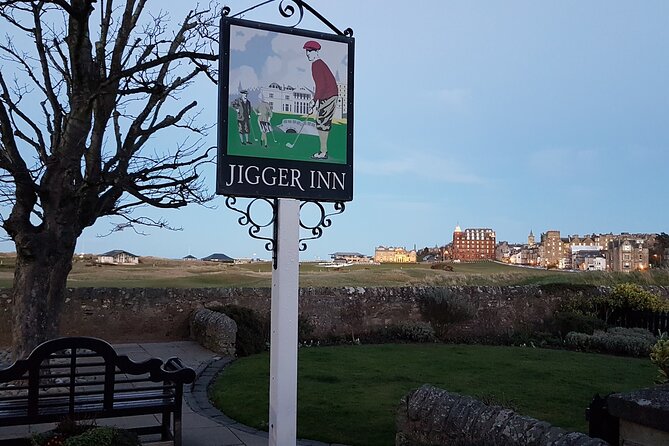
The walk ends near the Road Hole, the 17th green, and the Old Course Jigger Inn. Richard discusses memorable moments at one of golf’s most famous holes before leaving you with a practical option: stop for food or a drink beside the 17th fairway.
Refreshments are not included, so plan to pay separately. The Jigger Inn is a useful ending because it lets you continue the experience at your own pace. One group received a recommendation for fish and chips there and considered it a highlight of the day.
The endpoint is near the Swilcan Bridge area listed for the tour, but the practical finish is by the Road Hole and Jigger Inn. That is helpful if you want to sit down afterward, though it means you should not expect a return to the starting hotel.
What the guide’s style means for you
Richard is the central reason to choose this walk. His experience as a former caddie gives the tour a personal angle that a self-guided stroll cannot match. He shares course knowledge, St Andrews stories, and moments from his own years around the Old Course.
He is also described as funny and energetic. His storytelling links legends to actual places, which helps the history stay memorable. He sometimes asks people to introduce themselves and say where they are from, making the small group feel more personal.
The tradeoff is his delivery speed. Some people found the information hard to follow because he spoke rapidly or kept to his planned presentation rather than pausing for questions. That is why the tour requires a fluent command of English. Speaking slowly or translating during the walk is not considered workable.
If you have hearing concerns, stay near the guide and ask about the ear buds used on some departures. If you prefer to stop often for discussion, you may want a private tour instead. The shared format keeps the price down, but it also means the guide must keep the group moving.
Timing, weather, and who should book
The walk lasts about one hour and 15 minutes. It is short enough to fit into a day trip from Edinburgh, though you need to allow time for the journey to St Andrews and for arriving before the meeting time. It also works well on your first full day in town, when the course layout and local history can help you plan the rest of your visit.
Book ahead if your dates are fixed. This experience is often reserved about 61 days in advance. That does not guarantee that every departure sells out, but it shows that the timing can matter during popular periods.
Weather is part of the bargain. The tour requires good conditions and may be canceled if the weather is poor. In that case, you can receive a different date or a full refund. Even on a dry day, bring a warm layer and rain protection. One person specifically advised dressing warmly because the weather changed quickly during the walk.
The tour suits:
- Golfers who want context before playing or watching the Old Course
- Non-golfers accompanying a keen player
- History fans interested in how a sport develops
- Families with children aged five and older, provided everyone can follow fast English
- Visitors who want a short outdoor activity with a local guide
It is not a good match for anyone who needs a stroller, walking frame, crutches, mobility scooter, or a place to store golf clubs. People with recent knee or hip replacements, sprained ankles, or similar problems should also choose with care.
Is $25 good value?
At $25, the tour offers a strong return if you want interpretation rather than simple access. Much of the Old Course can be viewed from public areas, and you can walk around parts of the town without paying for a guide. The fee pays for Richard’s local stories, the structured route, the history of the course, and the arranged Swilcan Bridge photos.
The value is greatest for a first visit. If you already know the course, the major championship moments, and the history of golf, you may learn less. The guide’s rapid presentation may also feel less useful if you want a relaxed stroll.
For a couple or family with different levels of golf interest, the price is easier to justify. The golfer gets course detail, while the non-golfer gets town history, scenery, and a clear explanation of why St Andrews matters.
Should you book the St Andrews Old Course History Tour?
I would book this if you want a short, story-led introduction to the Old Course and can follow fast spoken English. The former caddie perspective, the fairway walk, and the Swilcan Bridge photographs make it more useful than simply taking pictures from outside the course.
I would skip it if you need a slow pace, extensive time for questions, guaranteed access during tournament play, or step-free equipment support. For most first-time visitors, especially mixed golf and non-golf groups, $25 is a sensible way to understand St Andrews before exploring the town or settling in at the Jigger Inn.
FAQ
How long does the St Andrews Old Course History Tour last?
The tour lasts approximately one hour and 15 minutes.
Where does the tour begin?
It begins outside Hotel du Vin St Andrews, at 40 The Scores, St Andrews KY16 9AS.
Where does the tour end?
It finishes near the Road Hole, the 17th hole, and the Old Course Jigger Inn. Food and drinks there are not included.
Is the tour conducted in English?
Yes. A fluent command of English is essential because the guide speaks at a pace that may be difficult to follow with translation or basic English.
How many people can join the shared tour?
The maximum group size is 15 people.
Are photos at Swilcan Bridge included?
Yes. Professionally taken photos at Swilcan Bridge are included, except on tournament days such as the Open or Dunhill events.
Is the tour suitable for people using mobility equipment?
No. It is not suitable for strollers, crutches, walking frames, or mobility scooters. There is also nowhere to leave these items or golf clubs during the tour.
Can I cancel for a refund?
You can cancel at least 24 hours before the start time for a full refund. Cancellations or changes made less than 24 hours before the start time are not refunded. If poor weather or an insufficient number of participants cancels the tour, you can receive another date or a full refund.
More History Tours in St Andrews
- St Andrews, Fife Coast Walk & Historic Abbey Tour from Edinburgh
★ 5.0 · 62 reviews - St Andrews History Tours
★ 5.0 · 41 reviews - Tour of St Andrews and Historic Fife Small Group Tour
★ 4.0 · 9 reviews - Old Town Walking Tour History and Tales in Edinburgh
★ 5.0 · 2,168 reviews
Just added around St Andrews
- St. Andrews Scenic Stroll: A Private Walking Exploration★ 5.0 · 6 reviews
- The Original St Andrews Photo Shoot Tour★ 5.0 · 7 reviews
- St Andrews Walking Tours★ 5.0 · 8 reviews
- A Wee Walk and a Cocktail in St. Andrews★ 4.0 · 7 reviews
- Private St. Andrews Tour with Dedicated Local Guide★ 5.0 · 38 reviews
- St Andrews History Tours★ 5.0 · 41 reviews
- Watch Building Experience – St Andrews★ 5.0 · 40 reviews
- Barrel-top whisky tasting in St Andrews★ 5.0 · 20 reviews
Historical Tours, compared.
Old Town Walking Tour History and Tales in Edinburgh
Read our review →

Multi-Sensory Small-Group Historic Vaults Tour in Edinburgh
Read our review →
Edinburgh Old Town: Historical Guided Walking Tour
Read our review →
Browse the lists this tour appears in